
For many young musicians, the path from a local program to a prestigious music school is rarely a straight line. It is often a series of pivotal moments, influential mentors, and the balancing act of competing passions. For one flutist, Miguel Rodriguez, the transition from high school student at the Larkin High School Visual & Performing Arts Academy to Northwestern University was defined by late but life-changing participation in CMPI.
Discovering CMPI
The journey toward a professional music career took a significant turn during high school. Miguel’s academy band teacher, Brendan Dobbeck, discovered CMPI and encouraged him to audition. Miguel’s parents were paying for private lessons out of pocket with his teacher, Scott Metlicka, Principal Flutist with the Rockford Symphony Orchestra, a financial strain familiar to many families supporting a budding artist.
Joining CMPI going into his senior year changed the trajectory of his development. Despite the timing coinciding with the global COVID-19 shutdowns, the program provided an immediate impact. “Once I was accepted to CMPI, the burden of paying for professional lessons was lifted. I was doing two lessons a week. It was a lot of information, but it was exactly what I needed because I felt behind the curve.”
Mentorship and Guidance
Beyond the financial support, CMPI offered something equally vital: mentorship and clarity. His mentor, Alexandria Hoffman, a Northwestern alumna and Civic Orchestra member, provided a blueprint for success. Miguel also continued working with Scott, who provided a methodical, logical approach to the flute, focusing on finger technique and articulation.
CMPI didn’t just help Miguel; it helped his family. For parents who weren’t musicians, the college application process for music is a labyrinth of trial lessons, financial aid appeals, and pre-screenings. CMPI bridged that gap, validating his talent to his mother and breaking down the sequence of events needed to transition into a top-tier university.
The Northwestern Shift: Performance vs. Education
Enrolling at Northwestern University, Miguel pursued a dual path in Music Performance and Music Education. This choice sparked an internal struggle between the stage and the classroom.
At Northwestern, he moved from being a big fish in a small pond to a small fish in a big pond. His collegiate studies shifted the focus toward interpretation, phrasing, and musicality.
Initially, he resisted the idea of teaching, wanting to focus solely on performance. However, reflecting on the influence from Brendan, his high school band teacher, he realized that music education wasn’t a “backup plan”—it was a way to help students become better members of society.
Despite this shift, Miguel contined playing and enjoyed performing with his quintet at Northwestern. In his last semester they competed and made it to the semifinals at the 2025 Fischoff Chamber Music Competition.
Resilience in the Face of Adversity
Professional growth is often forged in difficult moments. Miguel had secured a one year contract with the Rockford Symphony Orchestra while he was completing his undergraduate degree. After preparing rigorously for a permanent position audition with RSO, his car broke down on the highway on the day of his audition. Missing the audition was a crushing blow, but the professional reality of music meant he still had to show up for the symphony rehearsal that evening, since he was a temporary member of the orchestra. “It was so hard to compartmentalize,” he recalls. “I had missed the audition, but I still had to show up and perform.” This experience reinforced the discipline and resilience required in the professional world.
Looking Ahead: An Uncertain Path
Today, Miguel is embracing a hybrid career. After graduating last spring, he accepted a position as a sixth grade band teacher in the school district he grew up in. Miguel is far from putting the flute down. After competing at Fischoff with his chamber group, he headed off to Kinhaven for a summer program that made him realize he did not want to give up performance. He views the upcoming year as a “working gap year,” using his afternoons to practice with renewed intensity as he prepares for graduate school pre-screening auditions.
Through strict time management, literally setting timers for long tones and technical exercises, he has learned to balance the demands of education and performance.
“I’m not ready to let the flute thing go,” he says. By merging the rigorous standards of a performer with the heart of an educator, he is carving out a career that is as balanced as it is ambitious.
Images
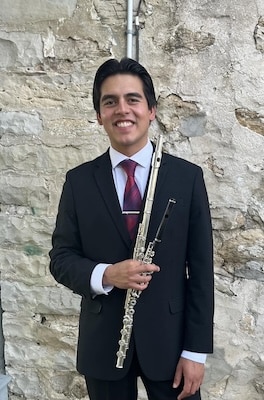
Stock photo, Miguel headshot