
On February 27 and 28, scholars and members of the Chicago Sinfonietta will present two free events focused on the life and music of Black Chicago composer Margaret Bonds, entitled Especially Do I Believe: The Legacy of Margaret Bonds. The Friday evening concert will feature some of her vocal and instrumental works at Pick-Staiger Concert Hall in Evanston. On Saturday afternoon audience members can hear a few more works, as well as scholarly remarks about her life and music, at Kenwood United Church of Christ. More information is here.
In preparation for this event, we thought we would introduce our CMPI family to Bonds, her Chicago connection, and her works.
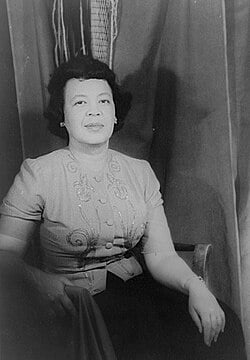 Born in 1913 in Chicago, Bonds’ early years were filled with music, as her mother, Estella Bonds, was a pianist, organist, music teacher, and church choir director. She grew up in a period of cultural richness for Black Chicagoans and was one of the earliest students at the newly founded Samuel Coleridge-Taylor Music School, originally at State and 36th Place in Bronzeville. Her first composition was penned at the exceptionally early age of five. As she grew older, she studied with pianist and composer Florence Price, who in large part helped to launch her career. She enjoyed a rich childhood, surrounded by artistic and musical dignitaries, including poet Langston Hughes.
At age 16, Bonds began studying at Northwestern University, one of the earliest Black women to matriculate to the university. The experience was challenging for her, as she began to confront racism daily, being prohibited to reside on campus or use the library or practice facilities. Instead, she spent time at Evanston Public Library, studying and reading poetry. She studied at Northwestern for several years, earning both a bachelor’s and master’s degree in piano and composition.
Despite these challenges, Bonds began to make a name for herself, winning the prestigious Wanamaker Foundation prize for her art song “Sea Ghost” while still a teenager. Other major accomplishments followed soon thereafter, the most remarkable being a piano performance with the Chicago Symphony Orchestra in 1933 – the very first Black person to play with the white, male orchestra – as part of their series Century of Progress at the Chicago World’s Fair. She performed John Alden Carpenter’s jazzy Concertino for Piano and Orchestra. The concert also featured the premiere of Florence Price’s Symphony No. 1, another first for the orchestra. The next year, Bonds appeared again at the fair, soloing with the Women’s Symphony Orchestra, playing Price’s Piano Concerto.
Eventually, Bonds moved to New York City, where she continued her studies at Juilliard and embarked on her career. She helped to develop the Black cultural movement in Harlem, founding a chamber music society and cultural center. During this time, she composed, taught piano to a large studio, and directed music at a church.
Many of her works are small in scale, focusing particularly on voice and piano, and often setting spirituals or the poetry of her friend Langston Hughes. Choral works make up most of the rest of her output. As she became older, she also wrote larger scale works, including theatrical works, musicals, and two ballets. Her music stretched beyond the classical canon, with pieces influenced by jazz and blues, including a number of works for the Glenn Miller Orchestra. She also composed several instrumental works, including the popular “Troubled Water,” from the Spiritual Suite for piano, and the orchestral work Montgomery Variations. The latter is dedicated to Martin Luther King, Jr. and depicts the civil rights struggle in Alabama, including movements on the bus boycott and church bombing.
Bonds died abruptly at age 59, a few years after moving to Los Angeles. She was honored by the Los Angeles Philharmonic in a performance of her work Credo, a cantata for choir and orchestra that blends traditional forms with spirituals and words of social justice, including a movement entitled “I Believe in Pride of Race.”
Like many Black composers – and especially Black female composers – Bonds’ brilliant works are underplayed and often unknown. In these times, they are becoming ever more relevant, especially her works on themes of social justice. They deserve a listen and a performance.
Images
Margaret Bonds, Stock photos