
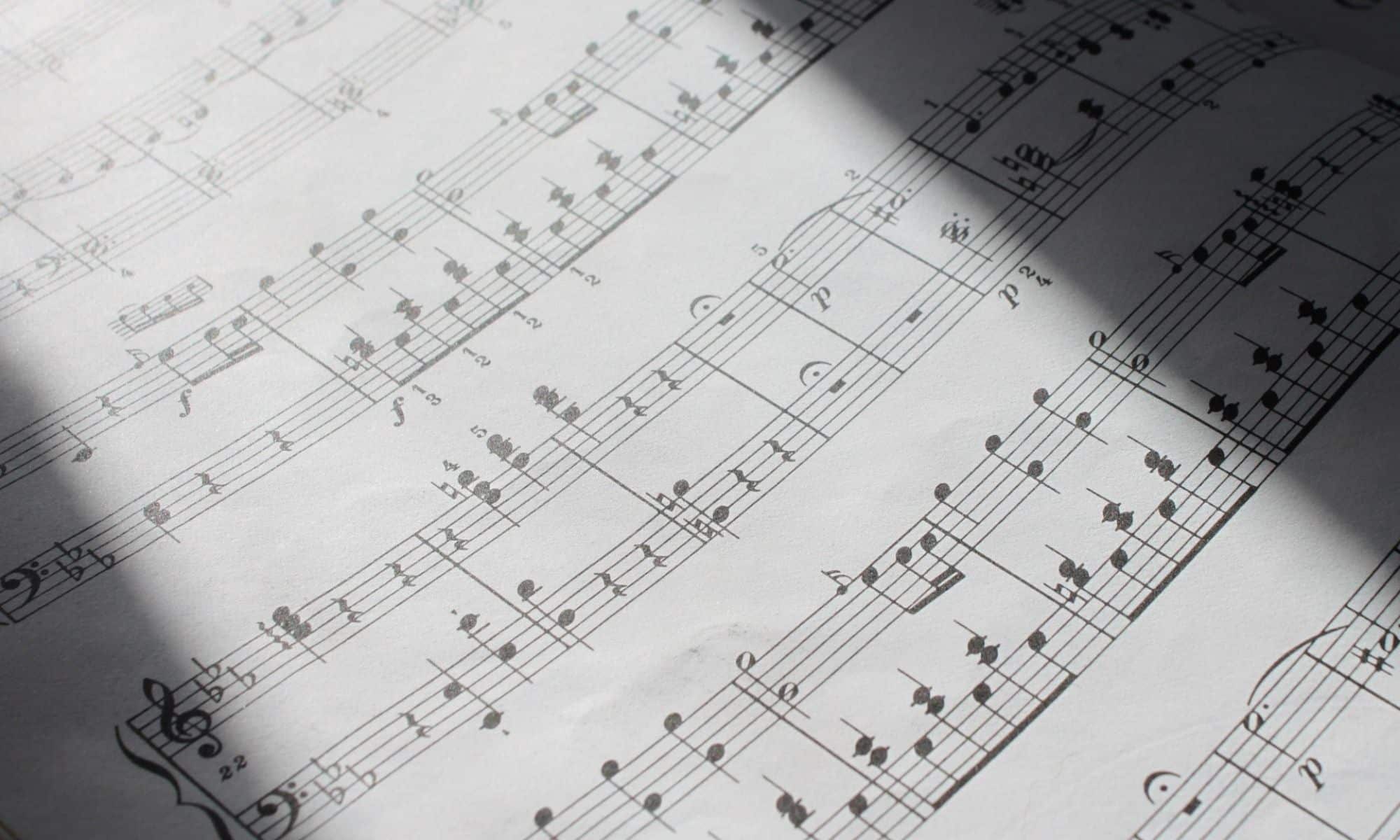
CMPI fellows have had a busy and successful winter, with numerous students winning or placing in local concerto competitions. Sometimes, students who win competitions are awarded the honor of performing their piece solo with an orchestra. Several CMPI students have had or will have this opportunity, and we asked them for preparation strategies and tips to help other fellows who are soloing with an orchestra for the first time.
Really know your score
When you solo with an orchestra, you must know how your part fits in. It is critical to study the full score – not just the piano score – and know exactly how your part works with the others.
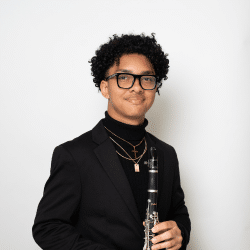
Caliel
Clarinet Fellow Caliel Mosley is currently preparing to perform the Weber Clarinet Concertino with the Northwest Indiana Youth Symphony Orchestra. He says, “I have been doing a lot of listening and score studying. As often as I can, I listen to my piece and focus on what the orchestra is playing. I look for figures and counter melodies so I can fully understand how my part fits into the whole orchestra.”
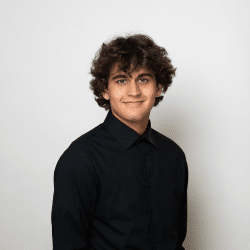
Neal
Violin Fellow Neal Eisfeldt has soloed with orchestra several times, including the first movement of Tchaikovsky’s Violin Concerto with the Fox Valley Symphony Orchestra in January of 2025. He states, “When preparing to solo with the orchestra, I had to work on understanding how the orchestra cooperates with the soloist. For this I used the orchestral score while practicing, to see how each individual part intercorrelated. This was very insightful as I continue to learn how a soloist at times is an accompanist, such as in the Brahms Violin Concerto, and is not always the main part.”
Another Violin Fellow, Aki Santibanez, has also played with orchestra a few times, including most recently the Sibelius Concerto with the South Loop Symphony Orchestra. She prepared by “listening to many recordings of soloists playing with orchestras. This would help me know how my part fits in while helping me memorize entrances.”
The orchestra cannot follow you like a pianist can
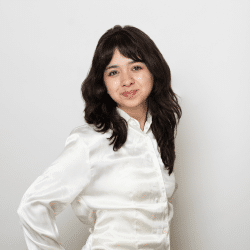
Neena
Viola Fellow Neena Agrawal played with the Symphony of Oak Park & River Forest last year and just started rehearsals to play the first movement of the Walton Viola Concerto with the Kishwaukee Symphony Orchestra. One thing she has learned is that, “There is one of you and up to 100 of them. They can’t follow dramatic changes. You have to be rhythmically clear and know when you can and cannot take time.”
Neal emphasizes that you must be as steady as possible. “Being as steady as possible is the key factor in order for the orchestra and conductor to follow you. It is really beneficial to practice with a recording and play along with it.”

Aki
Aki also wants to make sure soloists know they can speak up if something is not going right. “Never be afraid to speak up whether to the conductor or to section leaders. You should never feel you must keep quiet when you feel uncomfortable with a certain section, if you want to change something, or if you just want to rehearse another spot one more time. In the end it is your solo and everyone is there to support you!”
Project and maximize your sound
When you play with an orchestra, you are typically playing in a larger hall with at least 30 to 50 or more other people. You need to be able to project your sound both above the orchestra and to all parts of the hall. For Neal, “What I realized is the violin needs to project more when playing with an orchestra to be heard in the hall. This, in my opinion, made me modify how I play with the orchestra.”
For Caliel, he is working on a singing quality to his sound. “As a clarinetist, it can be a bit harder for us to play artistically without embellishments like vibrato that string players have, so our number one goal is to make our clarinets sing. I sing my piece how I would like to play it on my clarinet, emphasizing phrasing, dynamics, and articulations to really make it musical. I also study opera, which is essentially the framework of how I want my clarinet to sound. I have been enjoying Leoncavallo’s Pagliacci, Bizet’s Carmen, and Puccini’s Tosca, just to name a few!”
Prepare mentally
Preparation is often more mental, coping with both nerves and performing in a new setting. Caliel was surprised by how much mental preparation he needs to do. He states, “I have been doing some mental training that my mentor has advised me to do, and that is internalizing the whole piece. The idea is that if I were to play the piece in my head, start to finish, it would be the same length as if I were actually to play it. This completely solidifies my knowledge of the work and allows me to better guide the orchestra when I am on stage.”
Aki thought having a whole orchestra behind her would be nerve-wracking, but she actually found it to be helpful. “I found it more comfortable since you have so many fellow musicians supporting and performing alongside you!”
Be confident
For Caliel, confidence is most important. “The most important thing when soloing is confidence! You have to exhibit confidence while entering, playing, and exiting the stage. You have to have confidence in your fingers and mind to perform the music. One of the things judges look for in a competition is stage presence. Will you be able to lead the orchestra on stage and still sound good? Are you going to move on stage, put on a performance, and embody the music? Or, will you just play the notes?”
Neena reminds us to remember that this performance is supposed to be the fun part of a competition. “You already won the competition! You already did the hard part.” The performance is the time to enjoy the experience and showcase your talents.
Know your etiquette
There are standard ways of entering, tuning, bowing, and shaking hands for a performer. Watch how some performers of your instrument handle this procedure so you can enter and exit smoothly, making sure to shake all the appropriate hands. Most commonly, you will enter after the orchestra has tuned, come on stage and stand to the right of the podium, shake the concertmaster’s hand, and bow. After you play, you will typically shake the hands of both the concertmaster and conductor and then bow before walking off stage.
Hopefully, many more of our CMPI Fellows will have the opportunity to solo with an orchestra in the near future, and can learn from the experiences of their fellow CMPI musicians.
Images
Student headshots, Stock photos